Before we understand problem-solving, let us first calibrate ourselves on ‘what is called a problem?’
A Problem
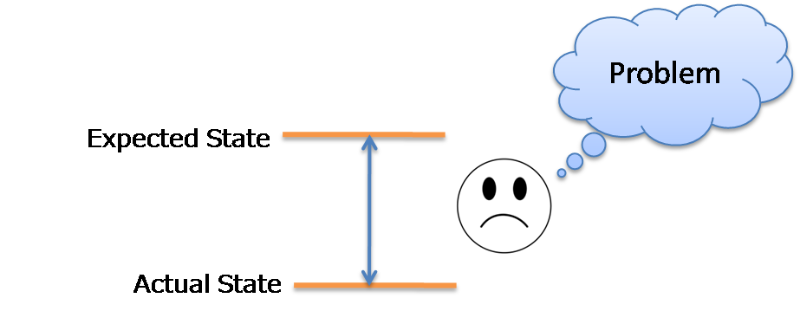
When there is a gap between our expectations and reality, we feel unhappy – which is a Problem. This is how a deviation from the specification, a failure to meet timelines, etc., become our problems. A problem could be defined as “the gap between our expectations and actual state or observation”.
From the gap analogy, we also understand that as the gap increases, our suffering intensifies.
Problem-solving
A fundamental part of every manager’s role is problem-solving. So, being a confident problem solver is really important to your success.
Much of that confidence comes from having a good process to use when approaching a problem. With one, you can solve problems quickly and effectively. Without one, your solutions may be ineffective, or you’ll get stuck and do nothing, sometimes with painful consequences.
Managing the problem (correction) instead of solving it (with corrective action) creates firefighting in our daily work. To solve a problem permanently, we need to understand and act on its root cause. We will also follow the steps of identifying root causes and prevent their recurrence in this workshop.
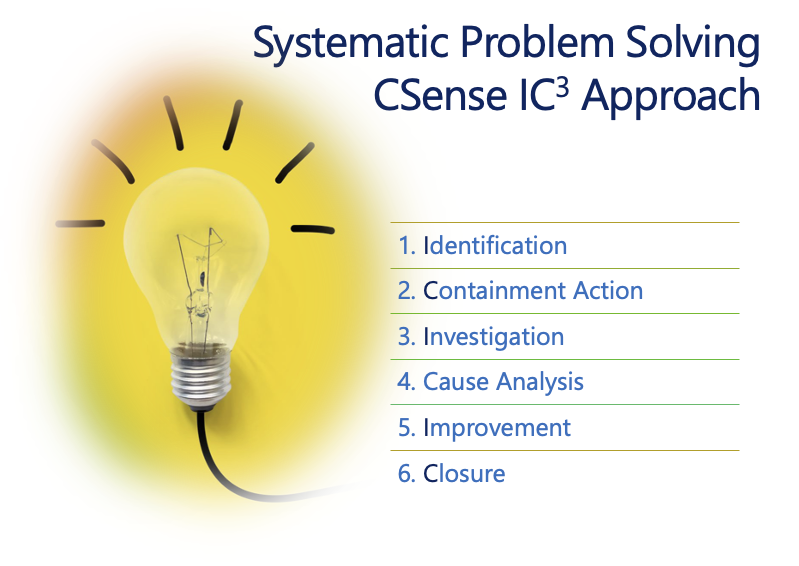
Systematic Problem-Solving
CSense IC3 Approach
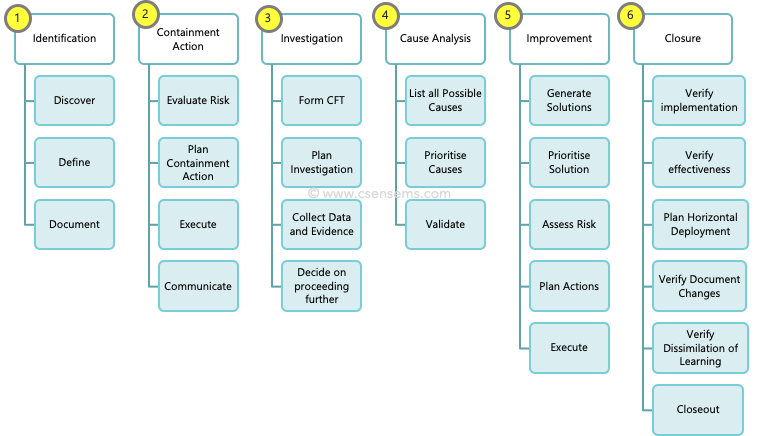
Identification
Containment Action
Investigation
Cause Analysis
Improvement
Closure
Systematic Problem Solving – Sequence and Flow
Applications of methodology
The methodology is simple and applicable to most of the problems faced by the industries. Hence, it is widely accepted and recommended by companies. This also forms a framework for Auto industries’ 8D Problem Solving, Pharma industries’ USFDA recommended 7 step approach and Six Sigma’s DMAIC approach.
The Problem-Solving workshop caters to leaders and managers who are interested in solving the recurring problems and want to bring in the culture and team-based approach of systematic problem solving to every level of people in the organisation. We deal with the most relevant tools in the step-by-step approach. We can take up the actual cases of recurring problems in the company as an example and study for the workshop. The course covers essential problem-solving tools like problem definition, containment action, root cause analysis with QC tools, root cause validation using statistical tools, corrective action, preventive action, escape points, Poka-yoke and more.
Course Objectives
At the end of the course, participants will be able to understand and appreciate
Cost of Poor Quality
The need for Systematic problem-solving
Various approaches to problem-solving
Difference between correction, corrective action and preventive action
Team approach enhance effective solutions and learning
Risk assessment and containment actions
Root cause analysis
Statistical tools
Arriving at an effective action plan
Preventing the defects
Target Audience
Managers responsible for process improvements
Quality Managers, Internal and External Auditors
Shop floor managers and supervisors
Production and Maintenance Managers
Product Design Engineers
Research Engineers & Scientists
Workshop Methodology
CSense Workshop approach is based on scientifically proven methodologies of Learning, which includes Learning by
Listening – Classroom sessions & Audio-Visuals
by Teaching
Doing
Examples & Exercises at the end of each step
Application
We will provide the required Templates and formats for each tool
During the course, we will form 3 to 4 cross-functional teams
We will help each team choose a specific problem (either an open Non-conformance or a recently closed out non-conformance)
We encourage the teams to choose different types of problems like Audit observations, internal failures/rejections, customer complaints, machine breakdown or accidents.
Then we will guide the participants to work on their assigned problem with the new approach – application & documentation.
Faculty will help the teams to apply the learning on the problems and explain the practical doubts.
After each step, teams will present their work.
Batch Size
Min 12 and Max 20 Participants per batch
Customisation
We can customise the deliverable as per client’s requirements.
Certification
Certification Criteria: 90% attendance in Training Sessions, participation in activities and 70% Score in written test
The test will be conducted on 2nd day of training
Laptop/desktop with provision to install software packages for participants to be arranged by the client.
AdditionalSupport
Continued coaching and hand-holding support could be provided by CSense after the workshop for successful project completion, as an optional engagement.


 By admin
June 27, 2021
By admin
June 27, 2021